Perspectives
03.11.25
Protecting our building stock: Adaptive reuse demands legislative progress

PORTRAIT
02.12.25
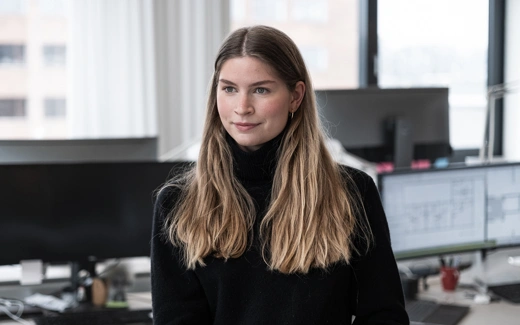
What is it like to work at a studio with a more than a century of legacy when in an industry that is constantly evolving with emerging technologies? To explore this, we talked to our colleague about change, hope, and curiosity.
When Driss saw his industry evolving faster than ever, he decided to embrace the changes, guided by his own curiosity. In this interview, he reflects on how his profession has evolved and how he navigates that change. He also shares his thoughts on what is important for innovation to flourish.
How did you start working at the studio?
"After three years working on all-things-sustainability at another studio – from circular material development, carbon strategies and calculations to bio/food-based material R&D – I decided I wanted to explore this new wave of computationally assisted design that started to emerge in the 2010s.
I had already been scripting in Grasshopper a lot and was generally very curious about all the new workflows that were being developed. AI and new tools were emerging as this new trendy craze, and although most of it was shallow and useless at the time (and in my opinion still mostly is), you could still feel a shift in the industry. A train was about to leave, and I wanted to be part of it.
I wanted to follow my curiosity and decided to reach out to Vilhelm Lauritzen Architects."

What potential did you see for the studio?
"I could see how a studio like Vilhelm Lauritzen Architects would benefit from a person working at the intersection of computational design, sustainability and broadly-speaking-AI. I saw it as an exciting challenge, to help ensure that the studio met the increasingly complex demands placed on the design and construction process to accelerate the transition towards more sustainable architecture.
The email seemed to resonate with management, and I got a call back. I pitched why my skill set was relevant and how I saw the importance of new tools; new geometries to optimise energy and resource consumption; and the role that a balanced circularity approach can play in increasing architectural value and cultural ties. And I must have done something right – because I was hired and started working at the studio in March 2025."
When the field of architecture shifts and transforms, what motivates your work?
"A key piece of context is that I spent most of my life living abroad – having lived on three continents and about twice as many cities by the time I turned 18. Born in Toulouse from French and Moroccan parents, I quickly replaced landscapes of cows and crops (mostly cows) with the cityscapes of Boston and Beijing."

"A cultural shock is understating what those transitions felt like at the time. But if anything, all those experiences exposed me to something I decided to shape my whole career around: people. People are what motivate me the most: their cultures, their ways of organising themselves in society, how they set about interacting with themselves and each other – and the role of architecture within it all."
How did you perceive the new technologies shifting the architectural industry?
"Like every YouTube-curious student at around 2018, I saw the Autodesk video (IYKYK) showing an algorithm coming up with multiple iterations of a floorplan. I was terrified, and couldn’t help but feel anxious and bitter as to the direction that my dear profession was going in. It seemed that the most precious aspects of architecture – its cultural significance and weight in society, its benefits in behaviour and emotion design, or its capacity to link cities and communities together – were going to be sacrificed for the sake of profit and efficiency.
My perception changed when I realised that for every algorithm or every generative script created, there are men and women behind it that handle its characteristics. And as long as people remain the directors of the orientation that these scripts have, all the precious aspects of architecture can be maintained. More so, they can even be developed and improved.
The biggest risk aren’t new tools. It’s letting go of what their underlying logic is. As long as we stay in control of that, we will all benefit from it – and most importantly, so will its users and people."

Which values do you think Vilhelm Lauritzen Architects should hold on to, even as the studio and the industry continues to evolve?
"Vilhelm Lauritzen arrived at a time when architectural ideas were at a clash: neo-classicists on one side, modernists on the other. He recognised the limits of the fading classicist approach but was humble, grateful and balanced enough to keep the healthy parts of its heritage intact.
One thing I admire a lot about Vilhelm and his legacy is how unafraid he was to stand against established customs and attitudes, when he felt it was right to do so. It was never about going against traditions for the sake of it. It was about allowing what needed to be shed to disappear and build on top of it.
In many ways I believe this culture is still present in the studio and was a large part of what drew me here. People will always have an open ear to new ideas, approaches, and methods of building. We are constantly encouraged to challenge our usual ways of building but doing so in a balanced manner. Here, we don’t necessarily strive to be the creator of new trends but instead have a team of people who will always listen and are easily convinced when presented with evidence for new innovations."
Driss has studied architecture and urban design at La Cambre in Brussels and has a master’s degree in architecture and engineering from Politecnico di Milano. He describes the two studies as having very different approaches to architecture and building – and loves how such opposite focus points fall under the same profession.
Since starting at the studio in March 2025, Driss has led sustainability initiatives on different projects and is now working on implementing tools to keep up with new waves, developments, and shifts in the industry.