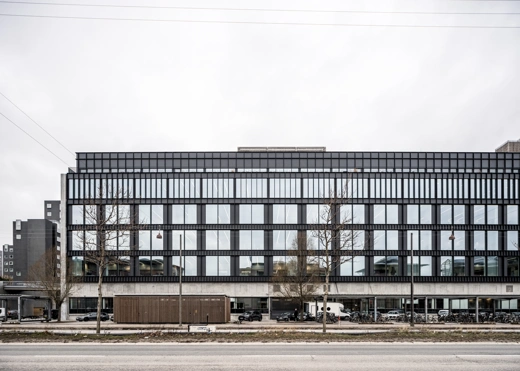
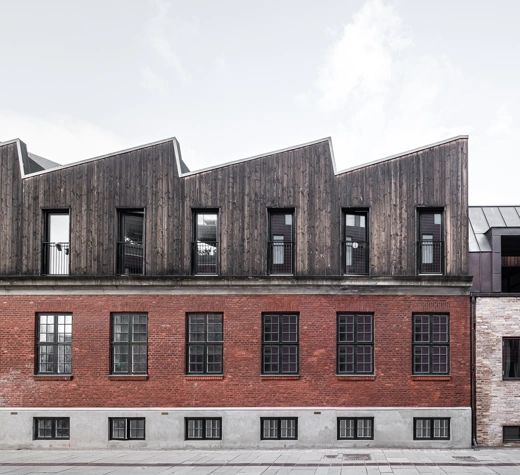
Novonesis Innovation Campus
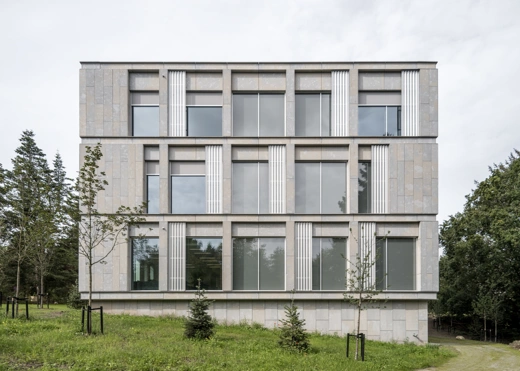

Preserving resources, memories and identity
Reuse, renovation and restoration of existing buildings are the most sustainable way to build. When we rethink and release the potential of the building stock we already have, we reduce CO2 emissions and the environmental footprint, extending a building’s lifespan significantly.
Making the most of the buildings we already have also allows us to physically capture and feel time; when we recycle and transform, we allow the generations to come to take part in and share our shared history and cultural heritage – and add new meanings and layers to them.
The most sustainable buildings, are those already standing.
Restrain
To move forward, we must increasingly look to the past. What we need is often already there, waiting to be revealed and reimagined. With this in mind, we approach adaptive reuse and renovation projects with respect and restraint, taking the time to understand existing structures, materials, details and stories before adding anything.
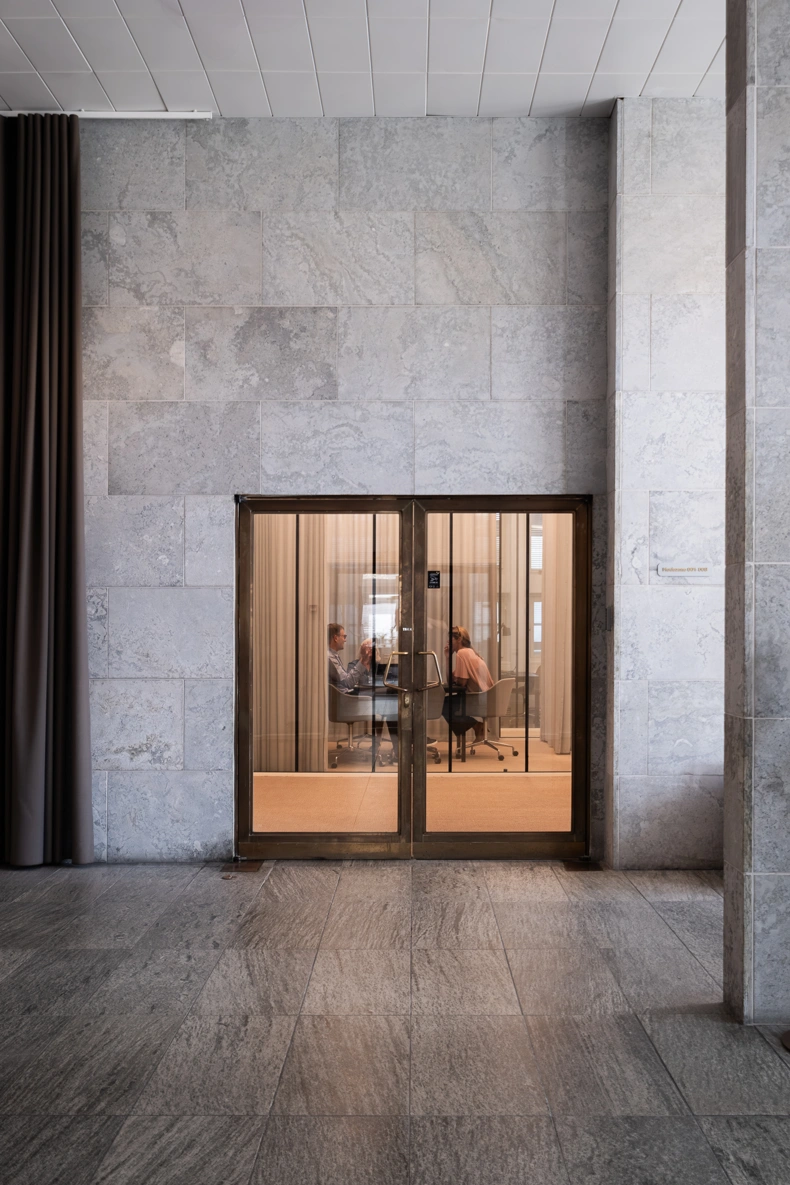
The renovation of Realdania’s headquarters in central Copenhagen demonstrates how restraint became the guiding principle throughout the process. From the outset, our ambition was to restore and reuse as much as possible – and discard as little as possible. By allowing the building’s original materials, craftsmanship and character to lead the transformation, we reimagined the workplace for present and future generations while preserving its modernist DNA.

Remain
In a time of increasing environmental and social pressure, we need to continually ask whether new construction is the only answer. We must always be critical towards the default options and be curious about what other solutions exist.
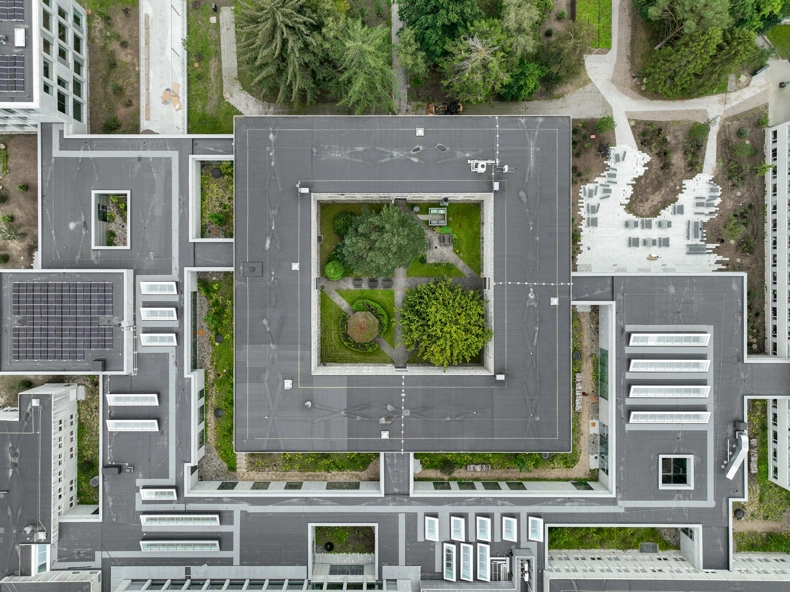
This was the case at Novonesis Innovation Campus when revitalising and extending the campus became the solution to having outgrown their home. Rather than relocating entirely, with close to 50,000 m² of new construction, which was the initial plan, we added a 15,000 m² extension to link the existing campus together. This not only reduced environmental impact and costs but also respected employees’ ties to the site and its setting.

– Malte Rosenquist, Partner at Vilhelm Lauritzen Architects
Repurpose
Transforming an existing building begins with uncovering its potential – even when it is not immediately visible. We approach adaptive reuse and renovation projects by looking beyond surface conditions to uncover the inherent qualities.
When we first encountered KB32, many saw a rough and run-down structure, particularly from the outside. But inside, the building revealed spatial qualities, material strength and character that would be impossible to replicate today. Buildings of this nature are no longer made. For us, KB32 represented a rare opportunity: a generous framework and a blank canvas, rich with possibilities. The project stands as a reminder that even the most unloved structures can be reborn.
Built in 1967, the infamous 180-meter-long building was once part of Copenhagen's railway district, serving as terminal and storage for freight wagons. Today, it is a modern office and multi-functional workspace for up to 1,000 employees.